


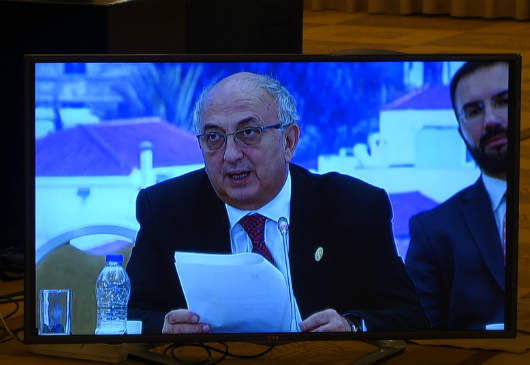
 I. AMANATIDIS: Mr. President of the Hellenic Republic, Your All Holiness, Your Graces,
Comprehension of the nature of conflicts that have to do with diversity, and finding the means to settle them in a way that strengthens and promotes democracy, is one of the major social and political challenges of our time. Conflicts based on race, nationality, gender, culture and faith take the global community back to a pre-modern level that in previous decades seemed to have been consigned to the past. These issues and conflicts are growing in strength at breakneck speed, in combination with economic and technological changes, demographic developments, and the emergence of a neo-nationalist ideological movement dominated by religious characteristics.
Contemporary geography and politics in the Middle East have been determined by the nationalistic movements of the region, which began in the 19th century. The greater part of the ongoing violence in the Middle East is related to frustrated struggles for self-determination and have their roots in colonial heritage. Before the First World War, the region was unified for about 500 years under the Ottoman Empire, although European colonialism, which appeared in the 18th century, competed for dominance as the Empire declines. After the First World War and the defeat of the Ottoman Empire, the European powers divided up the rest of the region into zones of influence, while the former Empire shrunk to the region that is today Turkey. Through to the middle of the 20th century, uprisings based on nationalistic ideals led to the whole region’s being released from European colonial dominance. The efforts to unify the old provinces under the idea of pan-Arabism failed, thus giving rise to nation states established geographically based on the old colonial borders. The limited success of many nations of the Middle East in providing adequate material and intellectual assimilation for their populations, together with the strong resistance to Western influence, led to a constant search for identity by the peoples of the region. The conflicts resulting from religious, cultural and race relations and idiosyncrasies are in large part a consequence of this search.
Today, the Middle East remains the field of an extended and bloody struggle for power and influence, which has enabled extremist groups to come to center stage. The sectarian and religious conflicts contributed to the gradual weakening and, for the most part, collapse of the state in countries like Syria and Iraq, as well as the reaffirmation of authoritarianism in other areas of the region. The situation of religious minorities points up the wider regional need for pluralism and tolerance, and needs to lead to the adoption of more effective peacemaking strategies to confront the suffering of the minorities, contributing to the production of greater stability on a long-term time horizon. However, these strategies will be successful only if the issue is approached with great sensitivity and attention to the wider context of changes in the region.
The traditional way of life and conduct, technological progress, and joining together with more progressive or conservative cultural schemata have in the past proven – if only in a fragmentary manner – to be legitimate factors that can be preserved in parallel. The states of the Middle East do not need to choose between modernity and traditionalism, nor is it entailed that one will have to survive at the expense of the other through the implementation of coercive measures. In fact, they could be rendered compatible if a balance is pursued with the promotion of tolerance, understanding for different needs and choices, as well as the building of methods of compromise. The negative stance against multiculturalism that appears to be prevailing needs to be replaced by an effort to consolidate democracy and tolerance, which entails the implementation of the same, recognizing that all peaceful cultural trends are legitimate within society.
The Middle East is in the midst of a period of transition, wherein instability and conflicts have contributed to the fragmentation of states and the deterioration of the legal order. In this context, citizens from all the social strata have been rendered vulnerable in terms of consolidation of and respect for their fundamental rights. However, there are also countries that are not at war and nevertheless have skewed legal frameworks that do not meet international standards, while many governments in the region have institutional weaknesses that hinder basic freedoms and rights. A lack of rule of law makes it much more difficult to protect fundamental rights and freedoms.
In the difficult effort to find an effective solution for the cessation of conflicts and for peacebuilding, we need to pursue cooperation with religious leaders, particularly those who have a strong foothold and long presence in the Middle East. Religious confessions do not exist only as embodiments of worship, but also have great potential for organizing local actions in order to activate players in the international community in favor of a just and equal settlement. From the top leaders of the churches to the members of the lay organizations, religious communities can help to promote the next diplomatic efforts towards conflict resolution.
Bearing in mind the past and present of religious and cultural pluralism in the Middle East, this geographical region takes on the aspect of an allegory for the social dynamic between globalization and fragmentation. Although it may seem as if the tragic events of the disintegration of Iraq and Syria have effaced the remaining memory of a common multicultural past, the centuries of peaceful coexistence of day-to-day people leave a great deal of room for hope that this will be rendered feasible again. In today’s framework of the globalization of common humanitarian values, the reaffirmation of the multicultural identity of the Middle East will contribute to the drawing up of a new social contract for coexistence; a contract that will protect plurality through the diversity of societies and empower the people of the Middle East to live in a peaceful and dignified environment.
Thank you.
October 19, 2015