


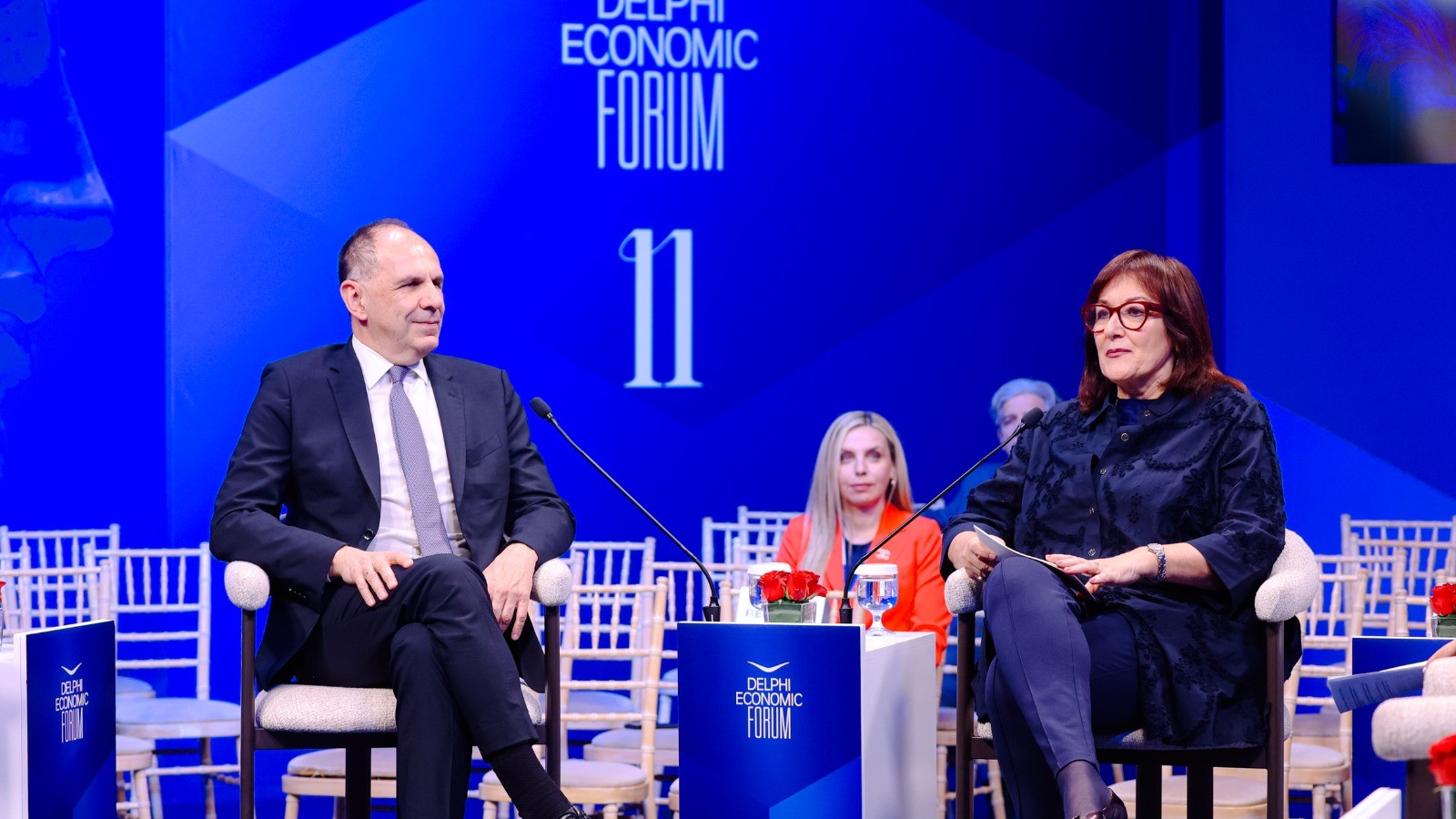
G. GERAPETRITIS: To start with, I would like to say that I'm really proud that I take part in this panel because Commissioner Šuica is a top-quality diplomat. But further, because she represents the Commissioner for the Mediterranean and Demography. It is of utmost importance that for the first time, we have a Commissioner for the Mediterranean, and exactly this reflects the significance attributed to the Mediterranean by the European Union. And it is not only a matter of geography or ownership. It is important that we place emphasis on the Mediterranean because this is exactly the network through which we establish our partnership with the Southern Neighborhood, with the Middle East, and with Africa. And I think it's truly important, given the current circumstances, to actually develop these synergies further. I think that it is clearly a paradox that we're having this discussion here in Delphi, because only through an oracle could we foresee the future, given the overall unpredictability of contemporary international politics. The truth is that we have completely lost any kind of rules-based approach. Not because power is now being imposed upon rules, but predominantly because at the moment it seems that we cannot work on any foreseeable scenarios.
What we're doing is that we're working on all possible what-if scenarios. So, it is important to have some benchmarks for the future, especially regarding the situation in the Middle East. I would like to add to what the Commissioner rightly pointed out, in the sense that this is a very dangerous and volatile situation in the Middle East, not only because it involves a significant number of states, some of them very powerful states, but also because there are a lot of things at stake. For example, we have for the first time, to such extent, the use of maritime freedom as a weapon of war. The second is that we see counterattacks to countries which are not directly involved in the armed conflict. And thirdly, we see an interlink of many regional conflicts. For example, the situation in Lebanon is interlinked with Iran and Gaza. And we have the situation in Syria. This is a new type of war, which indeed presents very peculiar and dangerous characteristics. Now, what is the impact for the Mediterranean, since we're here discussing about the Mediterranean with the Commissioner? Apart from the humanitarian aspect, I would say that we are going to encounter the ramifications of the war in the Mediterranean.
First of all, we might see a surge in migration flows because of the overall situation, especially in Lebanon. At this moment, we have 1.2 million Lebanese people who have been displaced. This is something that causes great concern about the situation, both from a humanitarian but also from a migration point of view. And of course, we have the issue of oil and petroleum supplies. The Commissioner has already mentioned the major effort by the European Union to actually diversify energy sources. And this essentially started from Russia's invasion of Ukraine. And indeed, we have succeeded in Europe to actually cut off the overreliance on - especially - Russian gas, so we are in a much better position now. But the truth is that the global economy relies heavily on freedom of navigation in the Gulf. Greece has been there in many respects. We have been there, especially leading the operation “ASPIDES” for the navigation through the Red Sea. But now it seems that we need to actually apply further standards of ship escorting also at some point in the Strait of Hormuz. There are a lot of initiatives coming from European countries, especially the United Kingdom and France, about the future of the Strait of Hormuz.
What I have to say categorically is that, first, we have to secure at all costs freedom of navigation worldwide. We cannot set a precedent of toll fees or any other kind of financial burden upon crossing any kind of strait. And the second is that we have to work very hard in the Mediterranean for interconnectivity. Interconnectivity is absolutely critical. What we need to do is to actually liaise Europe with the Southern Neighborhood. We are working very hard for the GREGY Project to link Europe with Africa. The IMEEC and the GSI, I think they're both very important. We need to work not only on interconnection of energy but also of trade, of data, of people, of communication. So, a lot of work for the European Commission, and we're very thankful to the Commissioner for her hard work.
JOURNALIST: Minister, I would like to ask you. Europe has many problems. Migration is one of these. It's in the frontline of the crisis in the Mediterranean. We have interests on interconnectors. We have many projects. And we have the problem of freedom of navigation. So, I would like your remarks to conclude this conversation according to what Ms Šuica said. And how can Europe answer all these goals?
G. GERAPETRITIS: Greece is indeed at the crossroad of a very challenging situation. We are very close to the Middle East and very close to Africa. We all understand what is happening currently in Africa. Obviously, the focus now is in the Middle East and in Ukraine, but the truth is that we have a humanitarian catastrophe in Sub-Saharan Africa, and this could have really destructive consequences in the very near future. We have to work preemptively in Europe, and we are doing a good job, I think, at the level of the European Commission, in order to have a very meaningful presence in Africa. I think the major issues are now, first, the migration issue. What we're trying to do is to set up direct channels of communication with the countries of origin, in order to, first, secure better surveillance; secondly, to secure returns of irregular migrants; and thirdly, to provide assistance for people at those countries, in order to stay there instead of traveling to Europe. As the Commissioner mentioned, we have this paradox, that at the same time we need to curb irregular migration, while intensifying legal pathways, because we need labor hands. So it's kind of a very tricky exercise, but we're working very hard. It is both at the domestic level and at the level of the European Commission.
The second challenge is interconnectivity. We are now having a lot of ongoing projects about interconnectivity in the Mediterranean. If you just see the map, the undersea map of the Mediterranean, it's amazing how many interconnectors there are in the Mediterranean. This is obvious, because you see that there are three continents essentially coinciding there, and the Mediterranean involves 21 countries from the 3 continents. So, we need to coordinate this, because it's very vital for European interests.
And third, and in my eyes even more importantly, I think we need to address the climate crisis. The Mediterranean is the epicenter of the climate crisis. We have a tremendous increase of the water temperature. We have a lot of species, maritime species that are endangered. We need to address those issues. It's not an easy task, but it is of vital importance. I think it's existential for Europe to try and curb the climate crisis. We are developing many projects. You do know that we are developing our maritime parks in order to protect the maritime environment. But there is no way that a single state or even a critical mass of states could address the problem. We need to work all together and we also need to involve other states.
JOURNALIST: How easy is it in the Mediterranean to work all together?
G. GERAPETRITIS: It's not that difficult. The problem is that we need to understand that the challenges and the problems are common. If you realize that problems are common, then solutions can only be common. Because the truth is that, even in case you have very meaningful, constructive and decisive policies to protect against the climate crisis, still, if there is pollution coming from Africa or from the Middle East, then you can achieve nothing. So, we need to work together. We need to also involve our Partners in the Western Balkans. We had this morning a very meaningful discussion with our Western Balkan Partners, and we signed the declaration, in order to accelerate the European path of our Partners in the Western Balkans. I think it's important that we provide a very clear signal for their path towards a European family. We need to understand that a state alone cannot address the problem. We need to work all together. There is not a single problem today that has only a unique aspect. So, it's important to elevate the solutions to a much higher level.
JOURNALIST: I want to thank you both very much.
G. GERAPETRITIS: It was wonderful. Thank you so much, and thanks to the Commissioner for being here. It's a great honor for us.
April 22, 2026