


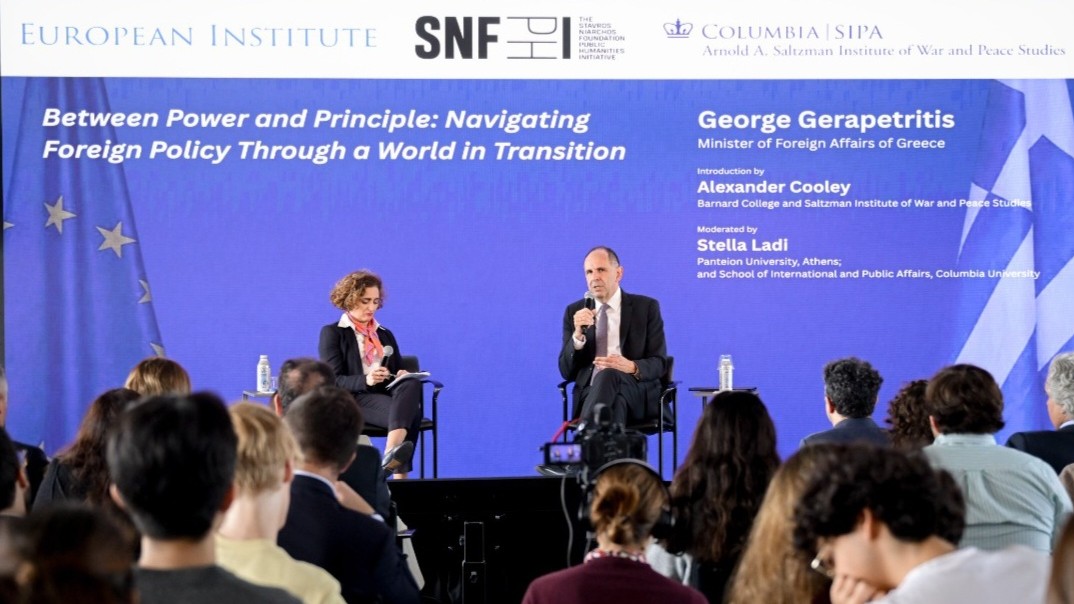
It's a true honour to be here at Columbia University, one of the most distinguished academic institutions worldwide. And I have to tell you that this is a moment of great pleasure for me because a brief escape from my duties as Foreign Minister is always precious to me. So, thank you so much for taking the time to be here, and thank you to the university and Alex and Stella for hosting me today. Indeed, it has been a very demanding week, the high-level week of the United Nations General Assembly, but this I consider to be one of the highlights of the week. So, please feel free to say anything. This is an opportunity to discuss frankly and openly about issues which are really acute.
So, I always wonder when I come to a university what percentage of my academic conscience I should devote. So, I have decided to maintain academic integrity when I talk to you, and I will try to be as factual as possible about what is happening in the world.
I will start with a statement, which is that geography today is much less relevant than it used to be, for many reasons. To start with, the challenges are global. We see armed conflicts which have domino effects in countries which are very remote. We see natural catastrophes which essentially influence the globe. We see situations with the mobility of populations, migration flows, especially irregular migration flows due to external circumstances. We see phenomena that will inevitably affect our lives, such as water scarcity or food insecurity, which are going to feature prominently in the political debates in the near future. Actually, I think water management is going to be the number one issue in the near future, with water scarcity potentially even becoming a source of armed conflict.
Secondly, what we see - in this “geography is not that relevant anymore” statement - are alliances that have been formed, which are completely cross-regional. We do not see the traditional kind of global multilateralism, like the United Nations, and then some regional forms of cooperation like the European Union. What we see is essentially cross-regional cooperation. Every state now is trying to reach out to more distant countries. And this is very critical, because the feeling is that distance is no longer an issue of insulation, it doesn't offer insulation to countries. So, what we really need to do is to build bridges with countries which are rather far away from ours in order to actually operate as multipliers for our collective protection.
And thirdly, we see external interference by states in other states on a very large scale. What we see in Africa, for example, nowadays, is truly amazing, astonishing, and regrettable. The truth is that especially what is happening in sub-Saharan Africa, in the Sahel zone, we have a very significant number of armed conflicts and we see external actors from far beyond Africa operating in these armed conflicts. They are not immediate stakeholders. Obviously, they do care about the critical minerals or other assets of those countries. So, they become partisan in civil wars or in armed conflicts between states. But the truth is that Russia, China, they are always there, and they aspire to actually affect even the outcome of the elections and the authority which is produced these days.
Now, given this, there is a paradox, I feel, which I would call “the power paradox”. And this is that power politics essentially return to the front line of the international arena, when the cooperation and multilateralism are more needed than ever because of those cross-regional challenges that we suffer. So, power politics become again a trend in international politics.
How would I define power politics to start with? Power politics have two basic features, the first is unilateralism, and the second is transactionalism. Unilateralism, because what we see is that International Law and multilateralism are essentially retreating towards unilateral action. Countries do not feel that they are bound by International Law commitments in order to get permission to do something. Whereas, on the other hand, transactionalism means that all states are trying to gain benefits from any kind of international activity. In order to allow a state to join an international organization, you may see some conditions set by existing members which are completely unrelated to the alliance itself. That type of transaction reflects, I would say, a trade viewpoint in international politics. It is truly a matter of power politics, which is produced nowadays.
And I think it's important - we were discussing with Alex about his book “Dictating the Agenda” - how strong states are now using the traditional tools of liberal democracies in order exactly to undermine democracies themselves through turning them into illegitimate democracies. And this is the point where we need to stand and do some serious reflection, I think. The first normative question would be if liberal democracies and liberal institutionalism, according to the classic theory of Kant, should be replaced by something more realistic, by - let's call it - political realism. Why in the first place should this be an issue? Because we see that multilateralism and rule-based order is seriously hampered because it turns out to be ineffective.
So, what we see is that we need a necessary corrective to utopianism, if we consider that the rule-based order is utopia. Normally, we refer to political realism by making a kind of cross-age bridge with ancient Greece and we attribute the idea of political realism to the famous historian Thucydides. I am not sure that this is the case. I will say a couple of words about Thucydides, because now it is very much in fashion and I know that you study a lot about those issues. But it is interesting because the idea that the political background of political realism is attributed to Thucydides was made by Nietzsche, in the first place. And I think that this kind of dilemma between political realism and liberal institutionalism is nowadays more relevant than ever.
Now, Thucydides was saying essentially two things, and this is why we consider him as an early authority of political realism. The first is what is now referred to as the “Thucydides trap”. What is the “Thucydides trap”? It is the inevitable clash between the dominant power and the emerging power. What Thucydides was saying is that, if you have an emerging power – and, from time to time, you do have emerging powers, this is the circle of history, you need to have emerging powers, otherwise you have historical stagnation. So, if you have, and when you have, the emerging power, it is inevitable to have a conflict with the dominant power. You cannot escape this. So, this is political reality.
The second statement that was made was about the relative power between strong states and minor states, weak states. He was saying - I think it's very traditional, it was quoted by the Canadian Prime Minister and it became very famous again - the famous quotation that right is only in question when we have equal parties, in any negotiation. If there is inequality, then what happens is that the one party, the strong party, imposes their will, whereas the weakest party suffers the consequences of this negotiation.
The reference is to the war against Milos, a Greek island, and there's some discussion whether Milos should be in the alliance of Athens or the alliance of Sparta. You do recall that in ancient Greece we had a very strong democratic state which was Athens, which is considered to be the birthplace of democracy, of direct democracy. And Sparta was the kind of strong military state which is considered to be the most powerful nation of Greek antiquity.
So, what happened was that the Athenians essentially tried to attract the Melians into their alliance, so as to take them out of the Sparta alliance. What happened was that the Melians essentially refused. Why? Because they thought they had a very strong connection with a god, and they over relied on Sparta. And eventually the Athenians destroyed Melos.
Now, there is a total misconception about what Thucydides is saying here, but the bottom line - and I think the moral discussion, the moral rationale of the discussion - should be the idea of the self-deception. When there is a power management, there is always a self-deception because everybody thinks that if there is a power domination, everybody's losing. This is the idea of Thucydides, because Thucydides thinks that there can be no absolute equality among parties. So, by definition, what happens is there is a relative power and eventually everybody loses.
Why did the Athenians essentially win the Melians property? Because the idea was that Milos should provide some military boats to Athens. But only a few years later, because of what happened with Milos, they had an operation in Sicily, Italy, and they were destroyed, and 25% of the overall population was essentially lost. Milos, the Greek island essentially lost because it was annihilated. The Athenians completely destroyed Milos, but Sparta also lost the influence they had in Milos. So, it was a totally lose-lose situation.
So, the idea is not whether we should replace a rule-based order with a political realism approach. The question should be how we combine those two. And this is the difficult question, whether they can be combined at all. And I think that those issues can be combined. Political realism should be combined with a principled international order because this is clearly the best idea. Now, under what conditions those two can be compatible is something that we could discuss for hours, but I would just like to make two premises which are relevant.
The first is that we need to place emphasis when it comes to political realism to political leadership and not hegemonism. The difference is critical. If you have hegemonism - “the hegemon”, according to Ancient Greek vocabulary - you have regular coercion upon the others. So, in spite of trying to actually reach a point to which you impose your will, coercion should be the actual mode to achieve it. And this is what true leadership should avoid. True leadership is essentially a matter of persuasion and not a matter of coercion.
And the second characteristic of leadership is deliberativism instead of transactionalism. What is the difference? It's obvious. Transactionalism, as we discussed, is a very common feature of the international security architecture today. But truly, my experience - at least in the last 3 years when we had the opportunity to participate in major events worldwide - is that what is lacking today in international politics is above all the deliberative spirit to reach rational decisions.
It's interesting, we were discussing with Stella before kicking off, the decision-making process within the European Union - and I know that this is one of your favorite topics. But look how post-war international security architecture was founded. It was founded on the idea of veto. Veto is the dominant decision-making process around the world. For different reasons. There is another paradox.
There is a veto paradox. Look at the United Nations. The United Nations are based on the veto by permanent members of the Security Council. The winners of World War II essentially demanded that they have a full right to refuse any kind of resolution originated by the Security Council. Υοu can obviously understand why for 5 years of a very fierce war of aggression of Russia against Ukraine, we do not have a single resolution about this situation because of the veto. The veto aspired to protect the strongest parts of the United Nations, the 5 strongest countries. That was essentially the nuclear weapon for the winners of World War II.
Now, European Union also applies veto. Where? In foreign and security policy. In order to reach a decision concerning foreign security policy within the European Union, you need to have unanimity. So, every single member out of the 27 member states of the European Union does possess a veto. Yet there's a totally different conceptual outlook in this idea. Why? Because here the veto power is essentially the weapon of the weakest. Because the strong states, if there was a majority or even a qualified majority - in all other judgments apart from the foreign security policy, there's a qualified majority, 55% of states representing 65% of the population, etc. But it's relatively easy for strong states to form a coalition and take any kind of decision. Yet the European Community treaties provided the veto power for every single member because they wanted to protect the national interests and the national identity of each member state.
And you see the paradox: in the case of the United Nations, the protection of the strongest member states, whereas in the European Union, the protection of the minor states. And this is clearly a very significant issue. Now, I think there is a solution. We are trying to navigate. It's not an easy navigation. And indeed, as Alex said, we have the strongest maritime fleet in the world. Greece represents more than 20% of the overall maritime fleet in the world. So, we do have a know-how of how to navigate. I think the important thing is for the West to stay together. And this is not only an abstract and conceptual statement. This is, I think, an imperative for us. The thing is that any kind of alliance operates as a multiplier.
I think ancient Aristotle - everybody knows Aristotle - put it very artfully by saying that the whole is greater than the sum of the parts. Because every part has a relative power, but if accumulated it all together, then the actual sum, what is produced eventually as a deliverable, is much more multiplied than a simple addition. So yes, we need to adhere to International Law. We need to adhere to multilateralism, not because we have no alternative. We need to adhere to multilateralism because this is the best model to actually address global challenges.
Yes, we need to do this in a more deliberative spirit. Yes, we need to work on decision-making processes in order to make them more constructive, more effective. Yes, we need to turn hegemons into leaders, true leaders, global leaders. But this is something that we should stand for. Αnd I regret to say that there is a critical mass of people, and even leaders of significant member states, who already think that multilateralism is dead.
For me, and I think for the majority of small and medium states, this is something which is very concerning. Τhis is very debatable to start with, and then it is very scary because you do understand that a civil society, an international community without rules and principles, is only a jungle. So, when we speak of multilateralism, please do not use nostalgic terms. It is still there and we need to work for this. Thank you.
September 24, 2026