


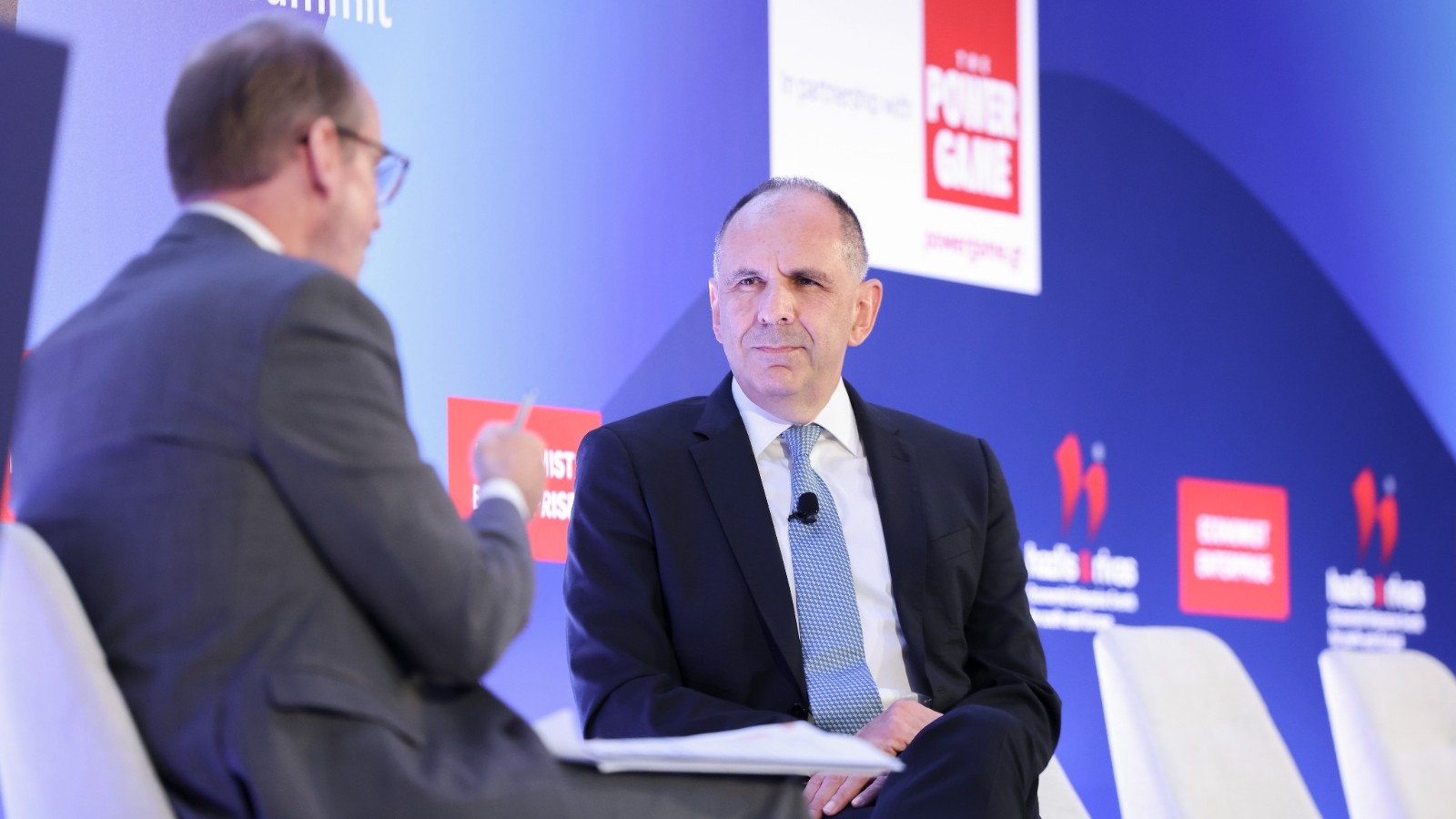
G. GERAPETRITIS: Thank you so much, first, for the invitation. It's truly amazing to be here at The Economist. And thank you so much Power Game.
It's lovely to have the opportunity to be here in Thessaloniki, a city with great history, and above all the city which connects the Balkans and the broader Eastern Mediterranean region. I think it's important to actually send a message from here, from Thessaloniki, that this region is of critical significance for Europe, for the stability of the region.
We all realize that we are now in the middle of a thunderstorm. It's probably the worst period after World War II. There are some tectonic geopolitical changes. We can see that there is an overwhelming overturning of geostrategic routes of electricity, routes of interconnectivity. I think the most spectacular thing happening at the moment is that we encounter at the same time three very unique political phenomena. The first is that we have these major changes in the geopolitical arena worldwide. The second is that we have a major shift in the way political communication is operating. And I mean above all social media, which have completely overturned the scenery of the media environment and how people are informed, but also the opportunities to actually develop misinformation and disinformation on a global basis.
And the third is that we see a new era of industrial revolution in the sense that artificial intelligence is completely changing not only the way people are thinking, but also the way political campaigns are operating, and the way people seem to perceive reality. Reality has become a truly blurred issue. I think now we are living in an era of political impressionism through AI. So, we have the three phenomena: tectonic geopolitical changes, artificial intelligence as a new revolutionary era, and change in the way media are operating.
We had these phenomena in the past, but not all at the same time. And this is actually a truly explosive mix, because this gives rise to a series of narratives which cannot be sustained. I think this is actually the golden era of populism and demagogues, because there are the vehicles to actually operate these false narratives. And on the other hand, there is ample space for all-out manipulation of people. So, I think this is a very complicated arena. And we see as a collateral a phenomenon which is not very positive and optimistic, which is the withdrawal of international multilateralism and international law. This is a truly frightening situation in the sense that one of the main pillars of the postwar world was the fact that we have a stable international security architecture.
Unfortunately, now there is a very shaky environment. International law still is the power of the weakest, yet I think that now "might makes right" to a great extent, and we need to actually develop synergies in order to make strong alliances in favor of international law and multilateralism against the strength of the powerful nations and leaders. This cannot be done by a single nation, by a single leader, but if we just unite towards this noble purpose, I think that we could be in a position to actually raise an obstacle to all kinds of revisionism and authoritarianism.
MODERATOR: Let's turn back to you, Minister, for a moment. I have this question for both of you, actually, but I think it needs framing slightly differently in each case. Greece notoriously went through a really tough time a decade or so ago. […] In the context that we've spoken about, Greece's own changing path and the changing context in which you operate, how do you now see Greece's responsibility as a member of the global community?
G. GERAPETRITIS: That's a very simple question to ask but a very ambitious one to expect me to respond to in a few minutes. I think you're very right and to the point, indicating that the difficult economic period that we went through was truly a milestone for Greece. In a sense, I think this type of unfortunate period essentially gave us the impetus to operate in a different manner. We have become very resilient, I think, to populism. This is a very significant factor that I'm referring to, because the truth is that in an era where populism is rising at tremendous heights throughout Europe and in the whole of the West, here in Greece we are still very resilient to populism.
The second aspect is that, here in Greece, we do value very highly the issue of political stability. For us, political stability is a key factor, and I think it's a true prerequisite in order to develop a stronger footprint in the international environment. With those two basic requirements, I would say that Greece has become essentially a very strong international actor in the last few years. We have managed to actually strengthen our standing by developing our alliances with strong regional actors such as Egypt or India or Israel, whereas on the other hand, what happens is that we have a very strong voice within international organizations.
We are going to hold the presidency of the Security Council of the United Nations in a few days, in October, at a very critical juncture for the United Nations, because there is also going to be the election of the new Secretary-General. And we have to deal with all kinds of turbulence around the world, whereas at the same time, in less than a year, we're going to hold the presidency of the Council of the European Union. Much of the Greek presidency is/ still lies ahead. And to be totally honest, we are at our best position to actually develop this new agenda for the world. What I need to say about our perspective of things is, first, that we have a very strong commitment, an unwavering commitment towards international law and multilateralism. I have already referred to this, but I think we need to actually do a significant recalibration when it comes to our values. I think nobody would object to the fact that we now enter in a totally different phase where realism becomes the predominant actor in international relations. But I have to insist on this, and on behalf of the Greek government and Greek diplomacy, I have to say that values should again be at the top of the agenda.
What we suggest is the model of values-based realism. We are interested in producing tangible deliverables for the world to try and re-install the idea of peaceful resolution of conflicts, but on the other hand, we need to do this by having full veneration towards the ideals that brought us here together. The second thing that we need to address is the interpretation of the new international environment. And I have the feeling that we are now in a phase of transition and a very painful realization about the new era.
I think there is a series of international phenomena which has proved one single thing: that dependencies are not actually a very positive phenomenon in international relations. We have, first of all, the rise of China, we have the Russian aggression against Ukraine, we have the new American administration and there is a common thread to all this. That suddenly there is a wake-up call that we shouldn't over-rely on alliances, we shouldn't over-rely on political phenomena, we should try to develop a sphere of autonomy. I'm not saying that alliances are not good. Obviously, in such an interconnected world, you need to develop strong and resilient alliances. But on the other hand, you should not be over-relying.
We see how energy routes have developed in the last few years. After the Russian aggression against Ukraine and the mere fact that before this, Greece and many other parts of the world were over-relying on Russian gas, we were forced to actually apply a new model when it comes to electricity. And now we're very proud to say that in the last five years we have become net exporters of energy here in Greece. And most importantly, we have become an energy hub for Europe and especially the Eastern Mediterranean. Now Greece essentially covers more than 50% of its needs from renewable energy sources, which means that in the long run this provides not only sufficiency for energy sources but also resilience of energy sources. So, we're very happy about this.
On the other hand, we have realized that when it comes to security, overdependence on the United States -and now I'm speaking as a European- was something that we need to revisit. And we did this in the context of NATO. There is a significant shift of balance when it comes to the defense industry. And here, as Europeans, now we develop the idea of strategic autonomy, meaning that now we have to be much more autonomous when it comes to defense. And this is why we now invest a lot of capital in the European defense industry and in synergies concerning defense.
Secondly, we develop new models of competitiveness in Europe in order to address the rise of China as a superpower in international trade, and we need to apply new models, new tools in order to be truly competitive.
And the third and most important, as it reflects our values. And all this on the basic understanding that we cannot compromise on our fundamental European ideals, namely social cohesion, and our social values, which is really a very distinctive feature here in Europe.
September 4, 2026