


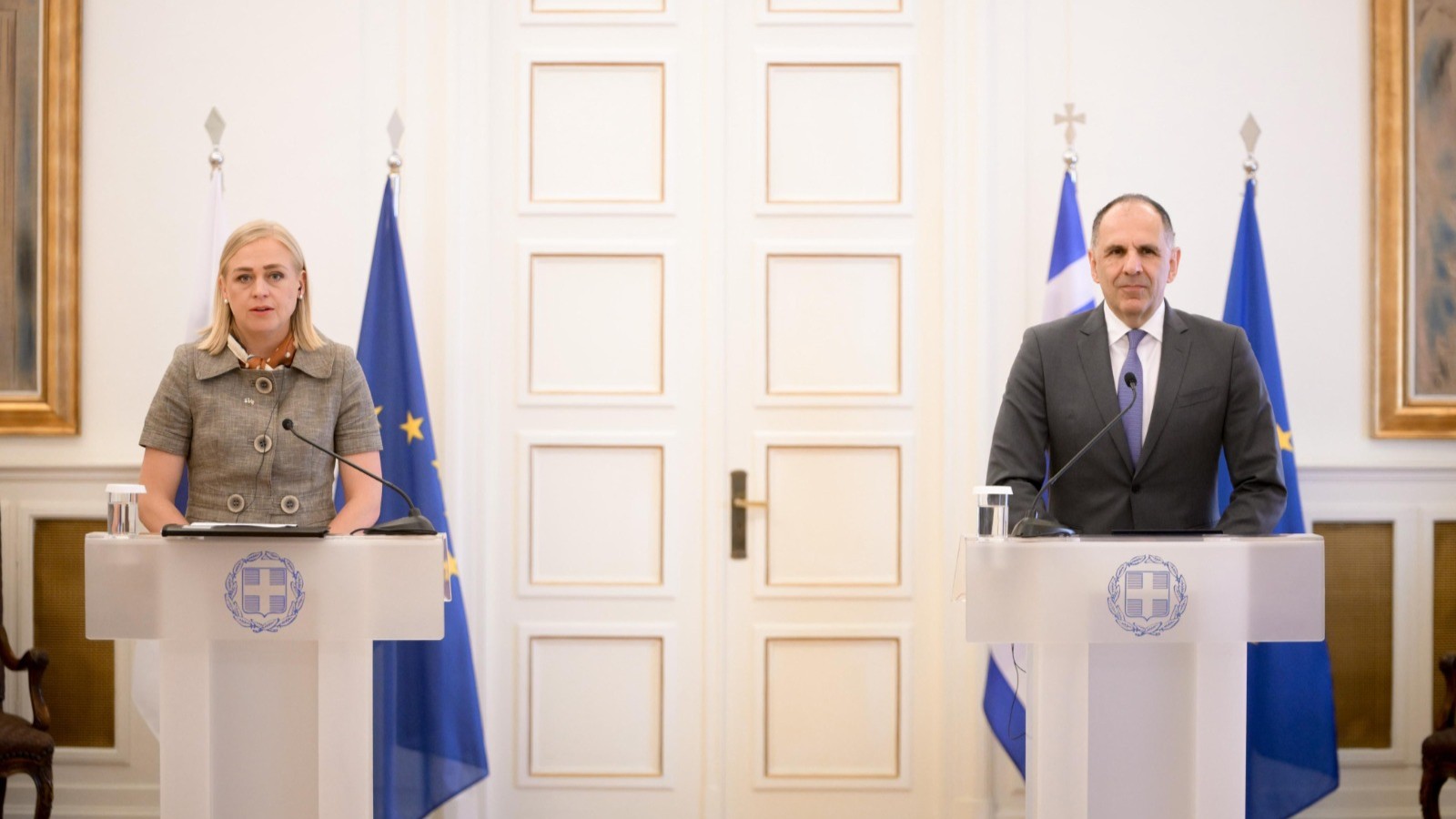
It is a great honor to welcome today at the Greek Ministry of Foreign Affairs, the Minister of Foreign Affairs of Finland, Ms. Elina Valtonen.
An exceptional Minister of Foreign Affairs, with valuable experience, broad knowledge, and a consistent view regarding Europe and its strategic autonomy. One of the most influential Ministers of Foreign Affairs in Europe.
Greece and Finland, partners in the European Union and allies in NATO, share common priorities regarding the complex challenges facing our neighborhood, in Europe, in the context of the current geopolitical juncture.
We have converging views on the future of the European Union: a strong, enlarged, and strategically autonomous Europe.
With regard to Enlargement, it is our common goal to integrate the Western Balkans into the European family, as well as to support our Western Balkan partners towards this aim. Greece, as the oldest member of the European Union in the region, remains a steadfast supporter of the European perspective of the Western Balkans, based on the principles of conditionality and own merits, with full respect for the Fundamentals, International Law, and good-neighborly relations that should underpin relations among states.
As for Europe’s competitiveness, we agree that it is necessary to build an environment conducive to growth, investment, innovation, entrepreneurship, and industry amid heightened geopolitical uncertainties.
Regarding the geopolitical Union, the three protracted crises in our wider neighborhood, in Ukraine, in Gaza, in the wider Middle East and in Iran, have demonstrated that dependency in strategic sectors, such as defense production, energy, and supply chains, may leave us vulnerable.
Therefore, the transition to strategic autonomy, while maintaining the strong geopolitical role for Europe in the world, constitutes a necessary condition and it is also necessary that we ensure meaningful diversification, so as to avoid overdependence in any sector providing infrastructure that is critical to the future of Europe and the world.
These issues, which are linked to the future security architecture of Europe, will also be discussed at the Foreign Affairs Council, which will take place this evening and tomorrow in Cyprus.
Finland and Greece, countries of the European North and the Mediterranean South respectively, share the conviction that geography continues to play a central role in geopolitical developments.
We consider it absolutely necessary to foster substantive dialogue among the regions of Europe as well. For this reason, together with the Minister, we develop actions, so as to establish a meaningful point of contact and a constructive and substantive dialogue on the critical issues concerning Europe, our neighborhood and its future.
It is clear that from the Arctic to the Mediterranean, the climate crisis - one of the major crises facing the world - is not only an environmental issue but also a critical factor for security and stability for Europe and the world. Without environmental balance, it is difficult to pursue meaningful sustainability in the world.
As countries of the Northern and Southern Neighborhood of the European Union and NATO, we face common challenges, as well as asymmetric and hybrid threats, which remind us that Europe’s security is indivisible. Threats no longer necessarily emerge through conventional means, but through means that are difficult for any State to confront on its own. For this reason, solidarity among states, solidarity among EU Member States, is absolutely essential.
For this reason, in both organizations - the European Union and NATO - the adoption of a 360-degree policy, a holistic policy that allocates equal attention and emphasis to all geographic regions, is a necessary condition for a meaningful and beneficial geopolitical strategy
As a nation with a long maritime tradition, Greece attaches particular importance to maritime security and freedom of navigation.
Accordingly, we oppose the existence of the shadow fleet, which directly violates the rules of International Law and freedom of navigation and surely constitutes a significant environmental risk. Greece is taking all necessary actions to address this phenomenon.
We also reaffirm our readiness to contribute to appropriate efforts in support of freedom of navigation in the Strait of Hormuz, when conditions permit, in full cooperation with all parties involved.
It is absolutely essential - and I would like to stress this - that security be ensured in all maritime areas, especially where there is very heavy traffic between continental and island regions. No action should jeopardize the safety of citizens and seafarers, as well as the safety of navigation.
Madam Minister, Dear Elina,
Last October, during my visit to Helsinki, we committed ourselves to working more intensively to strengthen our bilateral cooperation. The economy, investment in new technologies and artificial intelligence - the great challenge of our time -and, of course, tourism, are areas of common interest to both our countries.
Today, we had an exceptionally constructive exchange of views on all these issues, and I would particularly like to thank the Minister for the fact that, despite her exceptionally demanding schedule, she already had the opportunity to engage, also with relevant stakeholders, on issues concerning the further strengthening of our bilateral relations and bilateral trade.
It is also our shared intention to maintain close coordination in international organizations, such as the United Nations and the International Maritime Organization (IMO), with the aim of promoting international legitimacy and multilateralism, principles to which we are both firmly committed.
We consider the faithful implementation of International Law, together with the strengthening of multilateral international organizations, to be a genuine prerequisite for prosperity, and we are working towards that objective. We must join our voices in support of multilateral diplomacy as an indispensable tool for addressing complex issues that transcend geographical regions and go beyond states and national boundaries.
With these thoughts, dear Elina, I would like to welcome you to Athens and thank you warmly for the highly fruitful discussion we had today, which we will continue this evening in Cyprus.
Thank you very much.
May 27, 2026